
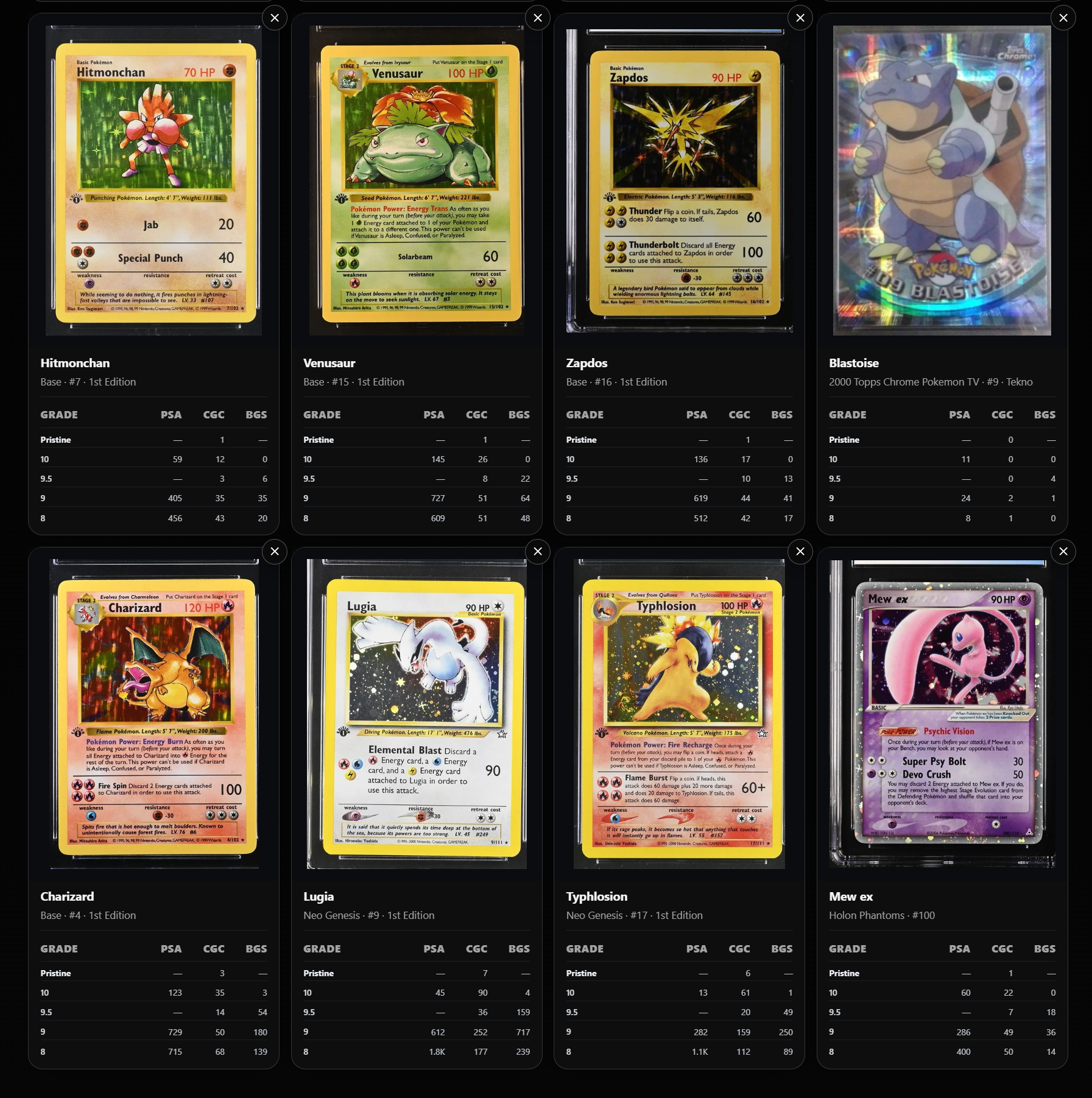
Start with Total Graded before judging PSA 10 count
A card with 150 PSA 10s means two completely different things depending on how many total copies were graded. If 150 out of 3,000 graded copies earned a PSA 10 (a 5% gem rate), that card is genuinely condition-sensitive. If 150 out of 180 graded copies earned a PSA 10 (an 83% gem rate), raw supply is simply easy to gem.
RareAlert displays Total Graded, Pristine / Black Label %, and Gem Rate directly above the individual grade breakdown so you always see the denominator next to the top-grade count.
Compare PSA, CGC, and BGS side by side
Looking at PSA alone can hide real supply—especially on modern chases, Japanese promos, and vintage cards heavily submitted to CGC or Beckett. Each company also splits top grades differently.
PSA tops out at PSA 10 Gem Mint. CGC separates Gem Mint 10 from Pristine 10 (and legacy Perfect 10). Beckett (BGS) awards Gem Mint 9.5, Pristine 10, and Black Label 10. RareAlert preserves each company's exact grade rows on every card page.
- Check Total Graded across all three graders to understand true slabbed supply.
- Compare PSA 10 against CGC Gem Mint 10 + Pristine 10 and BGS 9.5 + 10.
- Watch out for Authentic or Qualifier slabs—headline totals reported by a grader can be slightly higher than the sum of numeric grade rows.
Use 10D, 30D, and 90D trends to spot supply velocity
Static population numbers tell you where a card stands today; population deltas tell you how fast new slabs are entering the market. Modern chase cards can add hundreds of new PSA 10s every month during peak grading waves, while vintage WOTC and Carddass holos often add only a handful per year.
On RareAlert card pages and My Collection cards, switch between 10D, 30D, and 90D windows to see exactly which grades are growing—and whether the gem rate is rising or tightening.
When a vintage holo adds +40 PSA 8s and +20 PSA 9s over 30 days with +0 PSA 10s, new submissions are confirming how tough the card is to gem.
Verify the exact edition, variant, and language
Population reports are only accurate when you are looking at the exact printing. Base Set Charizard has four distinct English printings (1st Edition, Shadowless, Unlimited, 1999–2000), and modern sets separate normal, Reverse Holo, Poké Ball, Master Ball, and promo variants.
Always confirm the card number, set edition, and finish before comparing a slab's price against a population count.
Frequently asked questions
Why is Total Graded sometimes slightly higher than the sum of grade rows?
Graders include non-numeric slabs—such as PSA Authentic, qualified grades (OC/MK/ST), or CGC AA/AU—in their headline Total Graded count, while the breakdown table lists numeric grades.
Are population reports inflated by cracked slabs and resubmissions?
Yes, especially on high-value vintage PSA 8/9 and BGS 9.5 cards that collectors crack and re-submit. That is another reason to inspect the full grade curve and recent 30-day growth rather than relying on a single number.
Which grading company has the largest Pokémon population?
PSA holds the largest total graded Pokémon volume overall, followed by CGC and BGS, though CGC and BGS carry meaningful share on specific modern, vintage, and Japanese cards.