
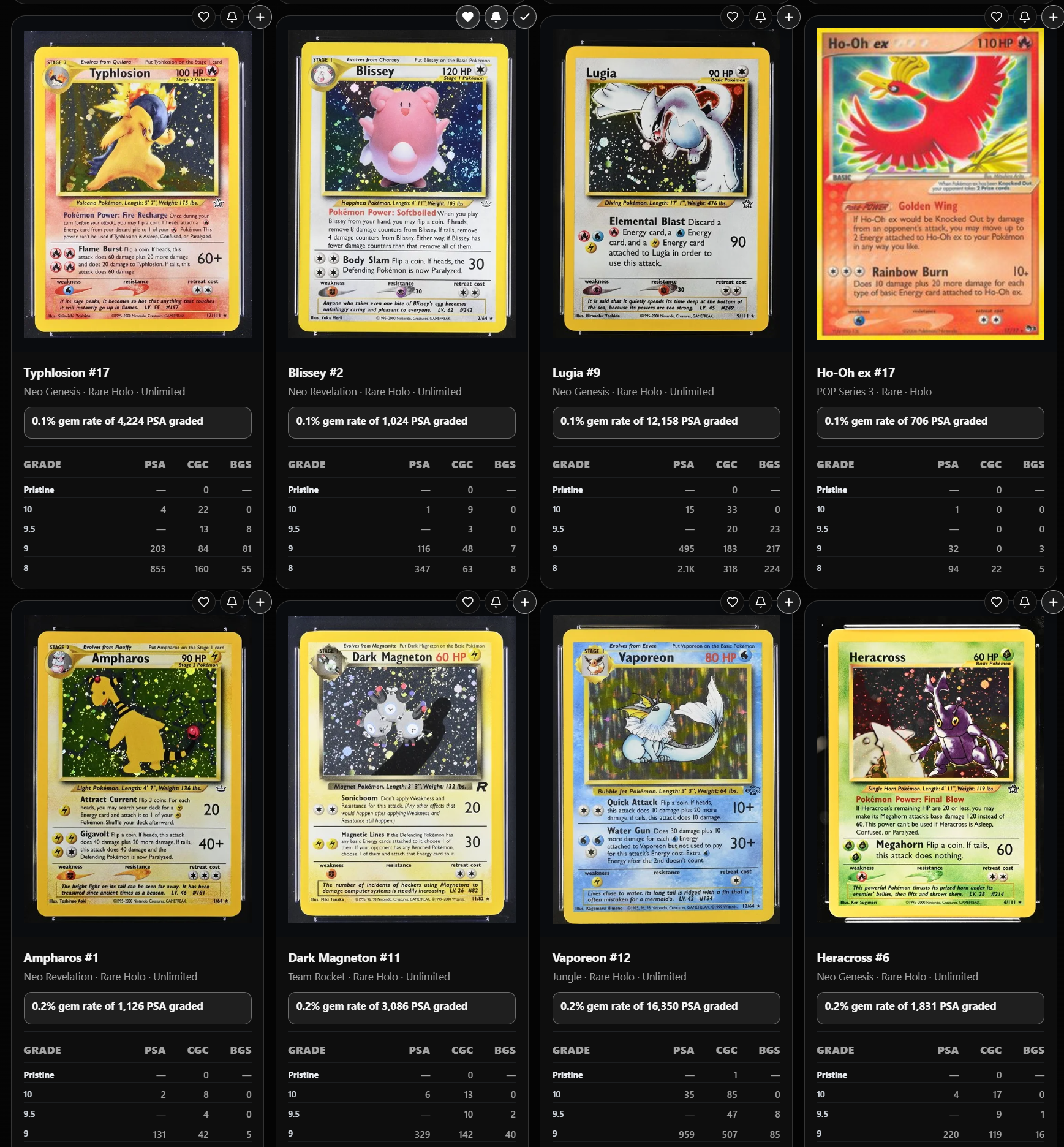
Typical PSA 10 gem-rate ranges by era
There is no single 'good' gem rate for every Pokémon card. Print stock, factory cutting, pack packaging, and decades of binder wear create completely different baselines across eras.
- Vintage WOTC Holos (1999–2003): Frequently 1%–12%. Iconic condition-sensitive holos like Base Set Charizard, Neo Genesis Lugia, and Typhlosion #17 sit well under 5%.
- Vintage Non-TCG & Vending (Carddass / Topps): Often 3%–15% due to vending-machine dispensing, prism borders, and thin cardstock.
- Modern English Holos & Illustration Rares (2016–2026): Often 20%–45%, dragged down by grid print lines, off-center cuts, and back-corner whitening (e.g., XY Evolutions Charizard #11, Paldea Evolved Magikarp #203, English 151 IRs).
- Modern Textured Alt Arts / SIRs & Japanese Prints: Commonly 50%–80%+ when pack-fresh quality control is strong.
Why low gem rate matters for collectors and pricing
Low gem rates create steep price gaps between PSA 9 and PSA 10. When only 5%–15% of graded copies earn a 10, submitting raw copies is expensive and risky—so buyers pay a heavy premium for an already-slabbed 10.
Conversely, when a modern chase has a 75%–85% PSA 10 gem rate, raw mint copies can convert into PSA 10s reliably, which tends to keep the PSA 10 premium closer to raw price plus grading fees.
Always check sample size alongside gem rate
A 0% or 5% gem rate on a card with only 12 graded copies is noisy and can jump after a single submission batch. RareAlert's Low Gem Rate leaderboard requires at least 100 PSA-graded copies so the percentages reflect real grading difficulty rather than tiny sample size.
On any set page, scroll to the 'Hardest to grade PSA 10' panel to see which holos inside that specific set have the tightest verified conversion rates.
Some modern cards (like XY Evolutions Charizard #11 or early Scarlet & Violet Illustration Rares) grade more like vintage holos due to factory print lines and centering.
Frequently asked questions
Is a lower PSA 10 gem rate better for long-term collectibility?
Lower gem rates restrict PSA 10 supply growth even when grading volume surges, which historically supports stronger PSA 10 premiums—as long as the card also has real collector demand.
Why do Japanese Pokémon cards usually have higher PSA 10 gem rates than English?
Japanese Pokémon print runs generally feature tighter centering tolerances, cleaner corner cutting, and fewer back-edge whitening defects straight from packs compared to English print runs.